
Devices
Three ways to mount a PoleFX pole. The pole itself is the same product in all three: a 46 mm tube of lit polycarbonate on 5 V DC, driven over Ethernet. What changes is what holds it up, and that decides the install, the wiring run, and whether it travels.
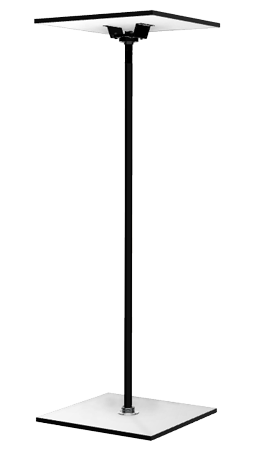

Permanent Pole
Rigidly mounted bearings on the top and bottom.
View details →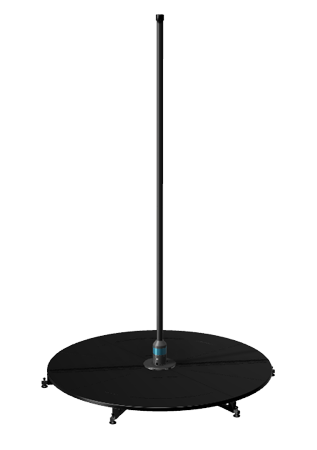

Portable Pole
No top support, mounted in a portable stage.
View details →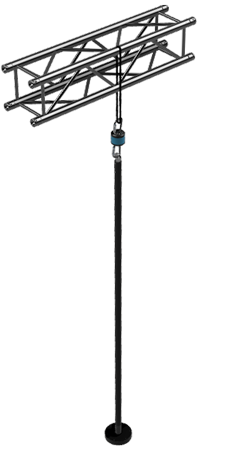

Aerial Pole
Suspended from an overhead rigging point.
View details →What each one asks of you
The mount decides who has to be involved and how long the job takes. Two of the three need a qualified professional before the pole goes anywhere near a performer.
- Height
- Built to your room, up to 143 in floor to ceiling, of which up to 120 in is lit.
- Who installs it
- A qualified installer fixes both mounts. We supply the mounts and the hole templates, not the fixings.
- Where the cables land
- At the top of the pole, inside the upper bracket.
- Moves?
- No. The mounts stay on the building even when the pole comes out.
- Read first
- Pole Setup
- Height
- 94 in assembled in one piece, 103 in as two sections that fit in a car.
- Who installs it
- You, with a partner. It mounts in an X-Stage Lite that PoleFX has modified.
- Where the cables land
- Under the stage, through a notch in one floor plate.
- Moves?
- Yes. Stage, pole and control kit each travel in their own cases.
- Read first
- Pole Setup
- Height
- 95 in overall, 84.5 in of it lit, sized to ship in an 8 ft tube.
- Who installs it
- A qualified rigger. We supply the pole and its top point and specify no rigging at all.
- Where the cables land
- At the top on a wired pole. A wireless pole has none: battery and player are in its base.
- Moves?
- Yes, wherever there is a rated point to rig it.
- Read first
- Rigging an aerial pole
What every pole has in common
Polycarbonate over a steel core, the same diameter on all three. A portable pole is narrower at the spigot that drops into the stage bearing, which is a different measurement of a different part.
Every pole takes power from its own supply and none from the Player. A dark pole is nearly always its own supply, not the network.
One cable carries the light data. The Player has a single Ethernet socket, so more than one pole reaches it through a switch. See Network.